
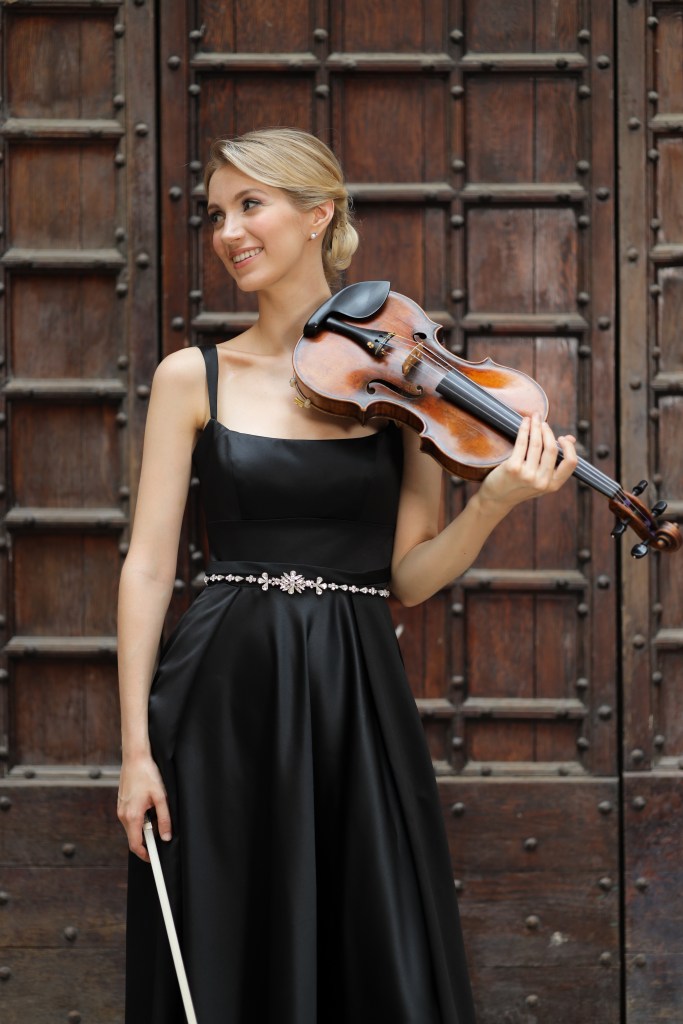
„la violinista Giulia Rimonda, una delle giovani interpreti italiane più interessanti della sua generazione. Tra Bach ed Ysaye, Kreisler ed Eric Tanguy, ha tracciato un percorso denso di virtuosismo e profondità.”
– Marco Turco, L’Unione Mongrealese –
Winner of the 2026 Villa Musica Stern Prize, Giulia Rimonda opened the 2025–26 season with the Chinese premiere of Respighi’s Concerto Gregoriano with the Beijing Symphony Orchestra at the Forbidden City Concert Hall and the Beijing Performing Arts Center. Next season, she will make her debut with, among others, the Deutsche Staatsphilharmonie Rheinland-Pfalz, the Aachen Symphony Orchestra, and the Chengdu Philharmonic Orchestra.
In the previous season, Giulia undertook a tour with the North Czech Philharmonic Orchestra, made her debut with the Orchestra della Toscana, and performed Tchaikovsky’s Violin Concerto at the Grand Amphithéâtre of the Sorbonne in Paris. She also began a three-year residency with the Orchestra Filarmonica Campana, inaugurated with Mozart’s Violin Concerto No. 3. Among the most significant engagements were the world premiere of Due cori per l’Agamennone by Salvatore Sciarrino at the Chigiana International Festival in Siena, and the Italian premiere of Music Pink and Blue No. 2 by Alan Fletcher at the Todi Festival in September 2025.
Over the past year she has collaborated with musicians including Kian Soltani, Marc Bouchkov, Adrien La Marca, Avi Avital, Petrit Çeku, Sarah Willis, Patrick Gallois, Mihaela Martin, and Frans Helmerson, performing under the direction of conductors such as Nikolaj Szeps-Znaider, Umberto Clerici, and Yang Yang.
Winner of numerous awards, Giulia has been Artist in Residence at the Società dei Concerti di Milano and received the Giovanna Maniezzo Prize of the Accademia Chigiana. She is also the recipient of the Roscini-Padalino Prize 2022 of the Fondazione Perugia Musica Classica and has been awarded scholarships from the Settimane del Teatro Olimpico in Vicenza, the Accademia Chigiana, CIDIM for the project Talenti Musicali Italiani nel Mondo, and the Associazione De Sono of Turin. Since June 2024 she has been selected as a fellow of Stiftung Villa Musica.
Particularly attentive to communication and to engaging younger generations with classical music, Giulia is the creator of Resonance, a video and audio podcast dedicated to the contemporary life of musicians. The project, developed in collaboration with the Associazione Amici di Giovanna Maniezzo (Rome) and promoted by WildKat PR, also takes shape in Resonance Live, a format of artistic residencies with events spread across the city and involving personalities from different fields – journalism, sports, universities, and schools – aimed at building bridges between disciplines and bringing new audiences to the concert hall. Upcoming editions include the Società dei Concerti di Trieste (April 2027) and the Konzertverein in Bolzano (November 2026).
Giulia currently lives in Berlin and studies with Sergey Khachatryan in the Solistenexamen program at the Hochschule für Musik Karlsruhe. Previously she lived in Paris, where she studied with Boris Garlitsky and was resident at the Maison de l’Italie (2022–2024). A former student of the Accademia Chigiana in Siena, she began studying the violin at the age of four with her father Guido Rimonda, and graduated at a very young age from the Accademia Nazionale di Santa Cecilia in Rome.
She regularly collaborates with the pianist Lorenzo Nguyen (Trio Concept). In March 2024 they released a CD for Suonare News featuring music by Respighi, Ravel, and Dvořák. At the age of fifteen she recorded Leclair’s Sonata for Two Violins No. 2, Op. 3 for Decca Universal, together with her father, for the album Le Violon Noir II. At nineteen she joined the editorial team of Archi Magazine for the online series Staccato, collaborating with artists such as Renaud Capuçon, Julian Rachlin, Vadim Repin, Luigi Piovano, Giovanni Gnocchi, and the Quartetto di Cremona in major Italian concert seasons.
Giulia performs on a 1720 Domenico Montagnana violin and on a 1983 Dario Vernè violin, named “Al tuo cammino”, generously donated by the Vernè family.
 Parera Management